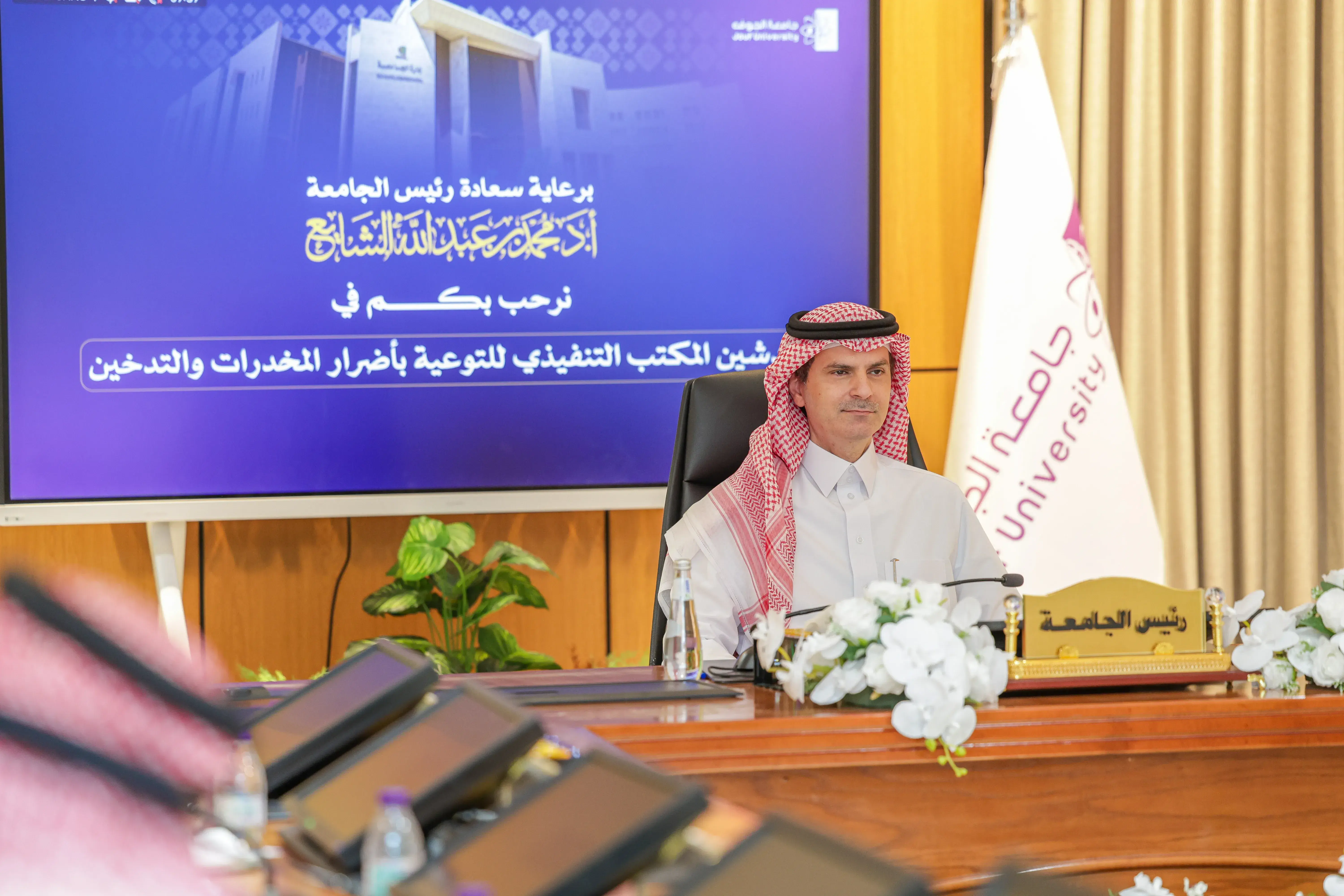
Jouf University President Launches Executive Office for Tobacco and Drug Harm Awareness to Promote Prevention, Protect the University Community, and Enhance Quality of Life

Under the slogan “Prevention Begins with Awareness,” and as a qualitative institutional step reflecting Jouf University’s commitment to human health and community safety, while strengthening its role in building a safe and sustainable educational environment, His Excellency the University President, Prof. Dr. Mohammed bin Abdullah Al-Shaya, inaugurated the Executive Office for Tobacco and Drug Harm Awareness.
The office marks the launch of an integrated system combining awareness, prevention, support, and scientific research. It aims to foster a culture of health awareness, promote positive behaviors, and protect members of the university community from the health, psychological, and social risks associated with smoking, drugs, and psychoactive substances.
The inauguration comes within the framework of Jouf University’s commitment to strengthening its national and community responsibilities and developing institutional initiatives with sustainable impact. This reflects the University’s recognition of the vital role educational institutions play in raising awareness, shaping individuals, and enhancing their ability to address health and behavioral challenges. The initiative extends beyond traditional academic responsibilities to actively contribute to prevention and community protection, reinforce individual and collective responsibility, and align with the objectives of Saudi Vision 2030, particularly those related to preventive health and quality of life.
The Executive Office represents a qualitative shift in the University’s approach to awareness and prevention, moving from isolated initiatives and activities toward a unified institutional framework. Under this framework, academic, health, counseling, media, and research efforts are integrated through clear mechanisms for planning, implementation, monitoring, and impact assessment. This approach enhances the effectiveness and sustainability of initiatives, ensures that awareness messages reach all target groups, and transforms prevention from a limited awareness activity into an established institutional culture and sustainable practice.
The Office’s vision is to achieve leadership in building an aware and safe university environment that embraces the prevention of smoking and drug use while promoting health and quality of life. Its mission is to raise awareness of the health, psychological, and social risks associated with these practices and reinforce preventive behaviors through specialized programs grounded in scientific evidence and approved best practices. It also seeks to integrate institutional efforts and effective partnerships while facilitating access to specialized support services.
The Office serves all segments of the university community, including male and female students, faculty members, employees, and other university personnel, as well as the local community. It adopts an integrated approach that considers the specific needs of each target group and employs modern scientific and educational methods to communicate preventive messages. Its efforts address the risks associated with traditional and electronic smoking, tobacco and nicotine products, drugs, psychoactive substances, and the misuse of medications, helping correct misconceptions and promote healthy behaviors.
The Office’s work is guided by three interconnected strategic goals: building a university community with greater awareness of health, psychological, and social risks; creating a university environment that supports prevention by developing skills and positive behaviors and encouraging help-seeking; and establishing a sustainable, measurable institutional model that unifies the efforts of relevant entities, develops partnerships, and links programs and initiatives to clear performance indicators reflecting their actual outcomes and impact.
In terms of specialized programs and initiatives, the Office adopts a diverse range of preventive and educational activities. These include comprehensive university-wide awareness campaigns, incorporating preventive messages into orientation programs for newly admitted students, and organizing events, lectures, and training programs across colleges and branches. It also offers programs targeting faculty members and employees, ensuring broad awareness coverage and reinforcing the concept of prevention as a shared responsibility among all members of the university community.
The Office also places particular emphasis on empowering students and young people and engaging them as active partners in promoting awareness and disseminating preventive messages. Through the “Prevention Ambassadors” initiative, it seeks to train a group of student volunteers to communicate awareness messages to their peers and participate in preventive activities and initiatives across colleges and branches. This approach promotes positive peer influence and harnesses young people’s potential to support health and community initiatives.
The Office further focuses on developing preventive and life skills that enable individuals to make sound decisions. Its programs address critical thinking, stress management, resistance to negative influences and peer pressure, and the adoption of positive health practices. These efforts contribute to developing informed individuals who can distinguish between safe behaviors and harmful practices and respond to different situations and challenges responsibly and with sound judgment.
To ensure integration between awareness and support services, the Office includes a specialized pathway to facilitate access to counseling, smoking cessation, treatment, and rehabilitation services provided by the relevant authorities. This pathway operates through organized support, referral, and administrative follow-up mechanisms that respect beneficiaries’ privacy, protect the confidentiality of their information, preserve their dignity, and encourage early help-seeking. This reinforces trust in the support system and underscores that prevention extends beyond educating people about risks to facilitating access to specialized assistance when needed.
The Office’s organizational structure reflects the University’s commitment to institutional integration and coordinated efforts. It is affiliated with the Office of the University President and operates through a supervisory, coordination, and implementation framework involving seven university entities: the University Counseling Department; the Deanship of Student Affairs; the General Administration of Human Resources; the Deanship of Graduate Studies and Scientific Research; the General Administration of Corporate Communication; the University Hospital and University Clinics Administration; and the Intellectual Awareness Department.
This structure ensures the effective use of scientific, specialized, administrative, and media expertise and promotes coordination across planning, awareness, training, counseling, scientific research, and outcome measurement.
Within this framework, participating entities undertake complementary roles, including providing psychological and social counseling services, implementing student and volunteer initiatives and activities, developing training programs for university personnel, producing media content and awareness campaigns, supporting medical awareness and scientific review of content, promoting critical thinking and behavioral awareness, and advancing research and studies that contribute to the development of evidence-based preventive interventions.
Scientific research occupies a central position in the Office’s work. Its activities include supporting studies related to preventive awareness and health behaviors, developing scientific tools to evaluate the effectiveness of programs and initiatives, and analyzing their results and impact on beneficiaries’ knowledge and behaviors. These efforts help leverage the University’s research capabilities to address community issues and connect academic knowledge with the real needs and challenges facing society.
The Office’s operational framework is based on four main implementation pathways: prevention and awareness; support and referral; partnerships and communication; and research, quality, and impact assessment. These pathways ensure integration between awareness-building and support services, strengthen cooperation with internal and external entities, and facilitate continuous program development based on evaluation results and performance indicators, ultimately establishing an institutional model that can be developed, expanded, and sustained.
At the implementation level, the Office has adopted a phased 90-day plan to establish and equip its operational framework and begin delivering its programs. The plan includes completing organizational arrangements, developing communication and support channels, training work teams, activating preventive initiatives, and monitoring and evaluating initial results. These steps will pave the way for the gradual expansion of programs and activities under a sustainable plan that ensures continuity and effectiveness.
The Office places particular emphasis on impact measurement and continuous improvement through a performance indicator system designed to measure improvements in preventive knowledge, the development of health and behavioral skills, the effectiveness of support channels, and compliance with healthy university environment standards. It also monitors the participation of colleges, branches, and relevant entities in implementing initiatives and assesses research outputs and scientific evaluations. This approach enhances program quality and ensures that initiatives deliver tangible results that can be monitored and further developed.
The inauguration of the Executive Office for Tobacco and Drug Harm Awareness reflects Jouf University’s commitment, under the leadership of His Excellency the University President, Prof. Dr. Mohammed bin Abdullah Al-Shaya, to developing specialized initiatives that integrate its educational, research, and community missions. It also demonstrates the University’s determination to harness its academic, health, and human resources to serve people, raise awareness, protect health and safety, and establish prevention as a fundamental pillar in building a prosperous and sustainable society.
Through this initiative, the University reaffirms that investing in people’s awareness and health is an investment in their future and the future of the nation, and that developing generations capable of making informed and responsible decisions is one of the most important foundations of sustainable development.
Jouf University will continue to advance knowledge, strengthen community awareness, and contribute to building a healthier and safer university environment under the slogan “Prevention Begins with Awareness.”