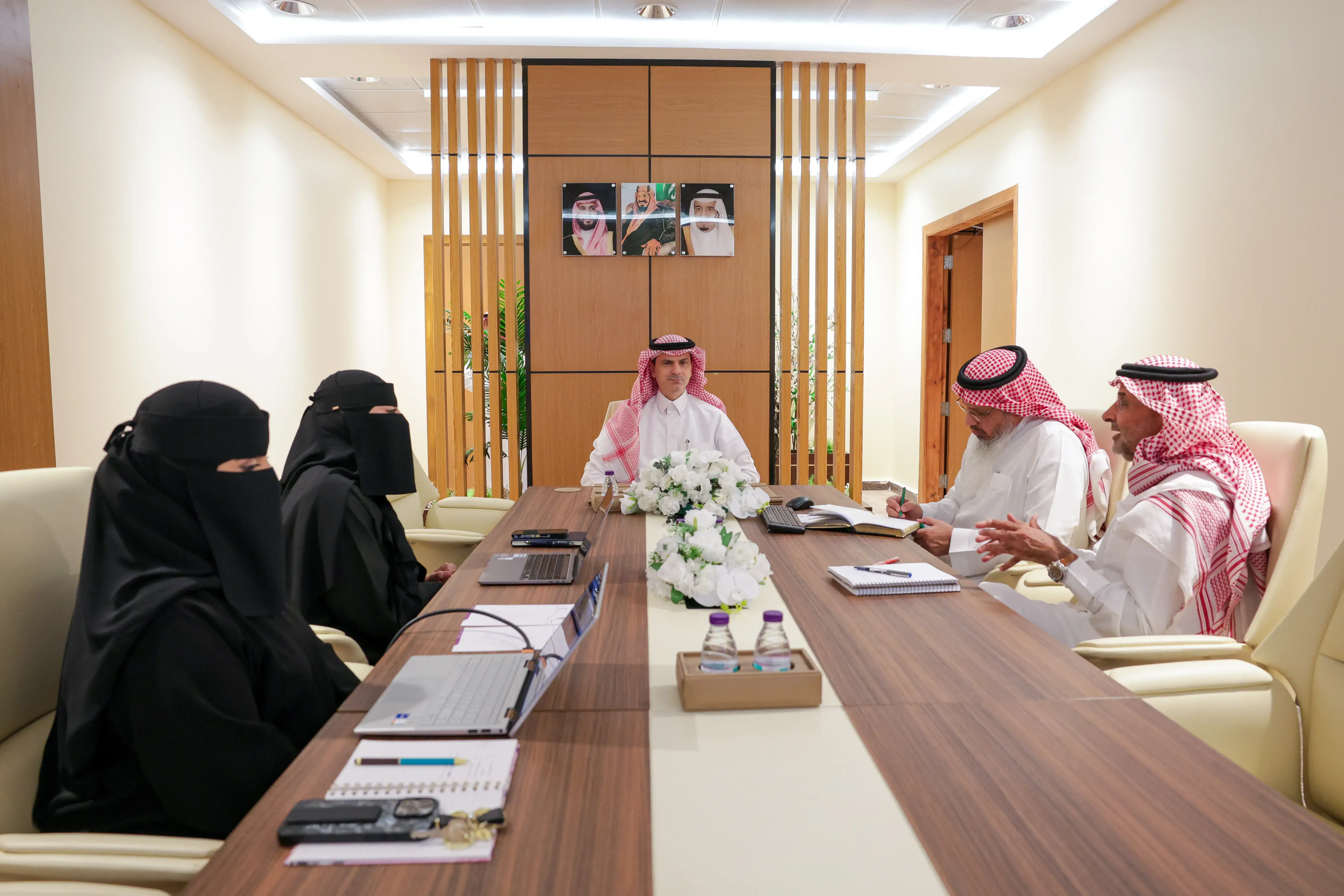
Jouf University President Prof. Dr. Mohammed bin Abdullah Al-Shaya Meets Data Management Office Team and Emphasizes: Reliable Data Is a Cornerstone for Decision-Making and Achieving the University’s Strategic Targets

The President of Jouf University, Prof. Dr. Mohammed bin Abdullah Al-Shaya, met with the University’s Data Management Office team in the presence of a number of University leaders. The meeting was held as part of the University’s ongoing efforts to review its data management and governance framework, strengthen the role of data in supporting decision-making, enhance institutional performance efficiency, and advance the University’s strategic objectives.
During the meeting, the University President emphasized that data represents one of the University’s most important institutional assets, noting that its accuracy, quality, integration, and governance form a fundamental basis for informed decision-making, performance measurement, and future planning. He stressed the importance of ensuring that University data is reliable, up to date, and integrated, and managed within a clear framework of policies, standards, and procedures that safeguard its quality, protection, and effective utilization.
Prof. Al-Shaya noted that the coming phase requires greater reliance on data and performance indicators in planning, decision-making, monitoring the implementation of initiatives and projects, and measuring their impact. This approach will enable the University to accurately track progress toward its strategic targets while supporting continuous improvement, greater efficiency, and enhanced quality of outcomes.
The University President highlighted the pivotal role of the Data Management Office in developing an integrated institutional framework for data governance, standardizing data sources and definitions, improving data quality and reliability, and regulating the processes of data collection, classification, and accessibility. He also emphasized the Office’s role in developing indicators and reports that transform data into actionable knowledge to support decision-makers.
He further stressed the importance of strengthening integration between the Data Management Office and all colleges, deanships, and administrative units across the University, while reinforcing each entity’s responsibility for the quality, accuracy, updating, and governance of its data. He affirmed that the success of the University’s data ecosystem is a shared institutional responsibility that requires integrated roles, clear authorities, and a high level of compliance with approved policies and controls.
Prof. Al-Shaya also underscored that Jouf University is placing significant reliance on the Data Management Office during the next phase as one of the key enablers for achieving its strategic objectives, supporting digital transformation and institutional excellence, and enhancing the University’s ability to measure performance, build forecasts, and make data-driven decisions. These efforts contribute to greater operational efficiency and the achievement of sustainable institutional impact.
During the meeting, the Data Management Office team presented its key activities and initiatives in data governance, data quality improvement, the development of guidelines, policies, and regulatory standards, and the enhancement of integration across data sources. The team also reviewed a number of future priorities and projects aimed at building a more efficient, reliable, and sustainable data environment.
At the conclusion of the meeting, the University President commended the efforts of the Data Management Office team and emphasized the importance of continuing to work in an integrated manner, accelerating initiatives related to data governance and quality, and developing an advanced data ecosystem that positions data as a foundation for planning, an enabler of decision-making, and a tool for measuring impact, achieving the University’s strategic targets, and shaping its future.