


Jouf University Reviews Academic Advising Report and Launches the “Smart Academic Advising Portal” to Enhance the Student Experience
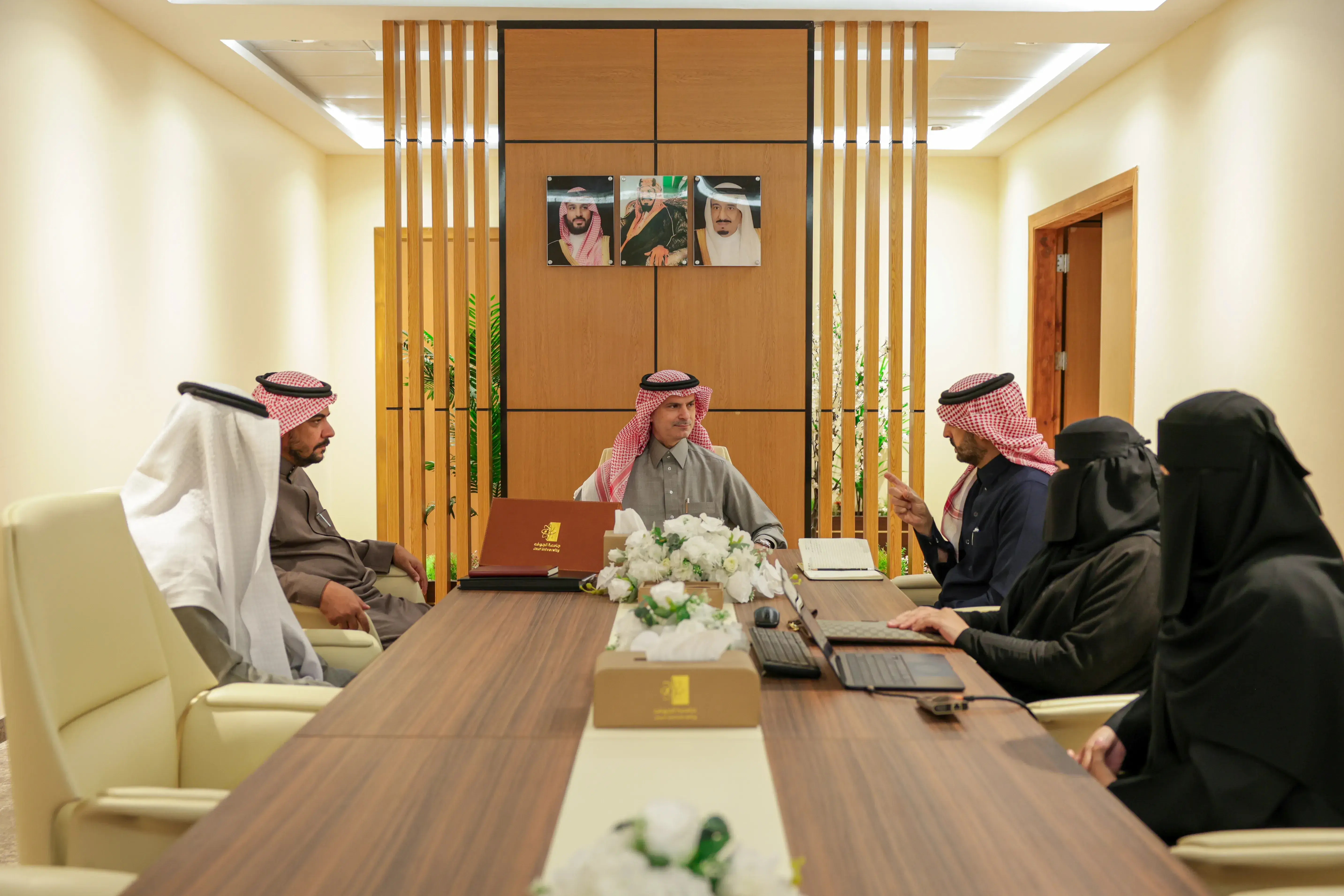
As part of Jouf University’s ongoing efforts to develop the academic support system and enhance the quality of students’ educational experience, the President of the University, Prof. Mohammed bin Abdullah Al-Shaya, received the Vice President for Educational Affairs, Dr. Alaa bin Saleh Al-Arjan, along with Dr. Fayez bin Khalaf Al-Anzi, Dr. Ohoud bint Abdulrahman Al-Dughmi, and Dr. Azza bint Khalaf Al-Lahham.
During the meeting, a comprehensive report prepared by the Academic Advising Administration was reviewed, highlighting the key initiatives and advisory programs implemented during the past period. The meeting also witnessed the launch of the “Smart Academic Advising Portal,” a qualitative step reflecting the university’s direction toward digital transformation and the integration of artificial intelligence technologies in developing educational services.
The report was presented within the university’s broader efforts to strengthen the academic advising system as a fundamental pillar in supporting students and enabling them to achieve academic success and excellence. The Vice Presidency for Educational Affairs reviewed the major initiatives carried out by the Academic Advising Administration to provide academic and psychological support to students, contributing to their academic stability and supporting the university’s strategic objectives of enhancing the quality of educational outcomes.
The report indicated that the Academic Advising Administration organized several advisory forums and dialogue sessions aimed at raising students’ academic awareness and strengthening direct communication with them. These included the First University Academic Advising Forum, which benefited 162 students, and an Open Dialogue Meeting attended by 453 participants, providing a platform for direct discussion of academic challenges and addressing students’ inquiries.

The administration also organized the Academic Probation Forum, which benefited 150 students, focusing on raising awareness of the causes of academic difficulties and ways to overcome them, while highlighting best advising practices that support students’ academic journeys.
The report further addressed the university’s efforts to address academic probation through a number of specialized initiatives and programs designed to support students and improve their academic performance.
Among the most prominent initiatives was the Academic Support Groups Initiative, implemented in seven colleges and benefiting 197 students, providing opportunities for collaborative learning and course review under the supervision of academic specialists.
The university also launched the “Together to Pass the Final Exam” Initiative, one of the largest student support initiatives during examination periods. It was implemented across nine colleges and benefited 1,719 students, with the participation of 73 faculty members, supporting 82 academic courses and enhancing students’ readiness for final examinations while improving their academic achievement.
In line with the university’s commitment to students’ psychological and social well-being, the report also highlighted a number of programs designed to enhance mental health and improve the overall quality of university life.
These included the Professional Skills Enhancement Program, which benefited 120 students, and the Psychological Preparation for Exams Program, which benefited 110 students. In addition, orientation programs for newly admitted students for the academic year 1447 AH were implemented, benefiting 163 students.
The administration also implemented the “Aware Student” Program for drug prevention, benefiting 350 students, the Support and Safety Program, benefiting 206 students, and the “What’s on Your Mind?” Initiative, which provided students with a platform to express their needs and challenges and benefited 105 students. Additionally, the Mobile Advisor Initiative benefited 50 students.
In supporting students with diverse needs, the Academic Advising Administration implemented several specialized programs aimed at empowering students and enhancing their integration into the university environment.
Among these programs was the Supportive Advisor Program for Students with Disabilities, benefiting 75 students, as well as the Adaptation Program for International Students, benefiting 160 students. The administration also organized the Sustainability of Inspiration Forum, attended by 180 students.
Furthermore, the First Advisory Forum for Students with Disabilities was held with the participation of 190 beneficiaries, in addition to implementing the “Your Talent Is Your Path to Excellence” Program, which benefited 219 students, aiming to discover and nurture students’ talents.
The report also highlighted the significant expansion in digital academic advising services. The number of students enrolled in university advising sections via the Blackboard platform reached 10,288 students, supervised by 400 academic advisors.
The university advising platform currently serves all 14 colleges of Jouf University, reflecting the broad scope of advising services and their integration within the university’s digital learning environment.


The report also reviewed the Academic Advising Excellence Awards, which aim to promote a culture of excellence and encourage outstanding advising practices within the university. These include:
- Best College in Academic Advising Award
- Best Academic Advisor Award
- Outstanding Student Award
According to the statistical indicators presented in the report, colleges conducted 134 advisory workshops and meetings, benefiting 7,443 students, while the total number of beneficiaries of advising services reached 9,882 students.
Additionally, 1,008 students benefited from orientation programs, while the total number of advised students reached 14,229, supervised by 972 academic advisors across the university’s colleges.
The report also highlighted a noticeable improvement in the academic probation indicator, where the rate decreased from 5.48% in the second semester of the academic year 1446 AH to 3.51% in the first semester of the academic year 1447 AH, reflecting the positive impact of advising programs and initiatives in supporting students and improving their academic performance.
As part of the ongoing development of advising services, the President of the University launched the “Smart Academic Advising Portal,” an advanced digital system for instant academic advising powered by artificial intelligence technologies. The portal aims to enable students to quickly and efficiently access accurate academic information through reliable official sources.
This initiative responds to several challenges associated with traditional academic advising, including increased pressure on academic advisors, long response waiting times, and the difficulty students sometimes face in understanding academic regulations and policies, highlighting the need for more flexible and efficient digital solutions.
The portal processes students’ inquiries through a smart system that searches a trusted academic knowledge base containing study plans, examination and absence regulations, academic advising guides, transfer and withdrawal policies, and other official references.
The smart system is expected to significantly enhance the university student experience by enabling instant access to reliable information, empowering students to make confident academic decisions, and reducing the burden on academic advisors by limiting routine inquiries and allowing them to focus on more complex cases.
The initiative also represents a strategic step toward transforming students’ inquiries and interactions into knowledge indicators that support the development of educational services and enhance institutional decision-making within the university.
During the presentation of the report, the President of Jouf University, Prof. Mohammed bin Abdullah Al-Shaya, emphasized that the academic advising system represents one of the key pillars of student success and the quality of educational outcomes, noting that the university places great importance on this area within its strategic plan.
He explained that the programs and initiatives achieved reflect the integrated efforts of the Vice Presidency for Educational Affairs and the university’s colleges in providing a supportive and motivating educational environment for students, emphasizing that investing in students is the true investment in the future of the nation.


He added that the launch of the Smart Academic Advising Portal represents a qualitative step in the university’s journey toward building a smart educational system based on modern technologies and artificial intelligence, contributing to improving the quality of academic services and enhancing the learner experience.
He further noted that these initiatives align with Jouf University’s strategic objectives in enhancing educational quality, supporting digital transformation, and developing student services, in line with the goals of Saudi Vision 2030 in developing human capabilities and building a competitive knowledge-based economy.
The President concluded by reaffirming the university’s commitment to continuously developing the academic advising system and adopting innovative initiatives that enhance student success and academic excellence, contributing to the preparation of qualified national talents capable of supporting the Kingdom’s development journey.
The university also confirmed that the current phase of the Smart Academic Advising Portal project includes performance evaluation, data collection, and analysis of usage patterns to support the continuous improvement of the initiative and enhance its impact on academic support services and the overall student experience.