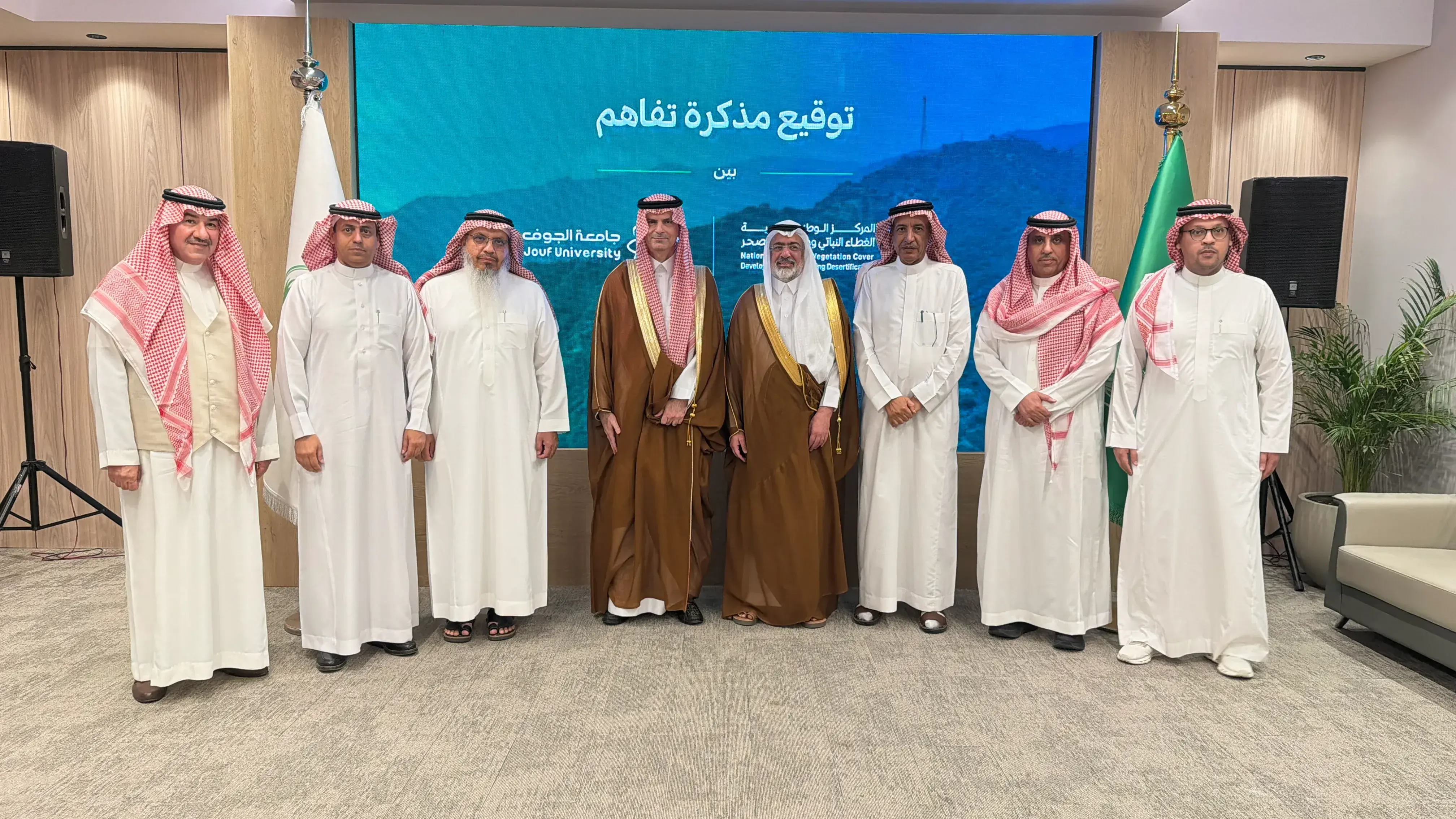
Jouf University Signs Memorandum of Understanding with the National Center for Vegetation Cover Development and Combating Desertification to Promote Environmental Innovation and Support Saudi Vision 2030 Goals
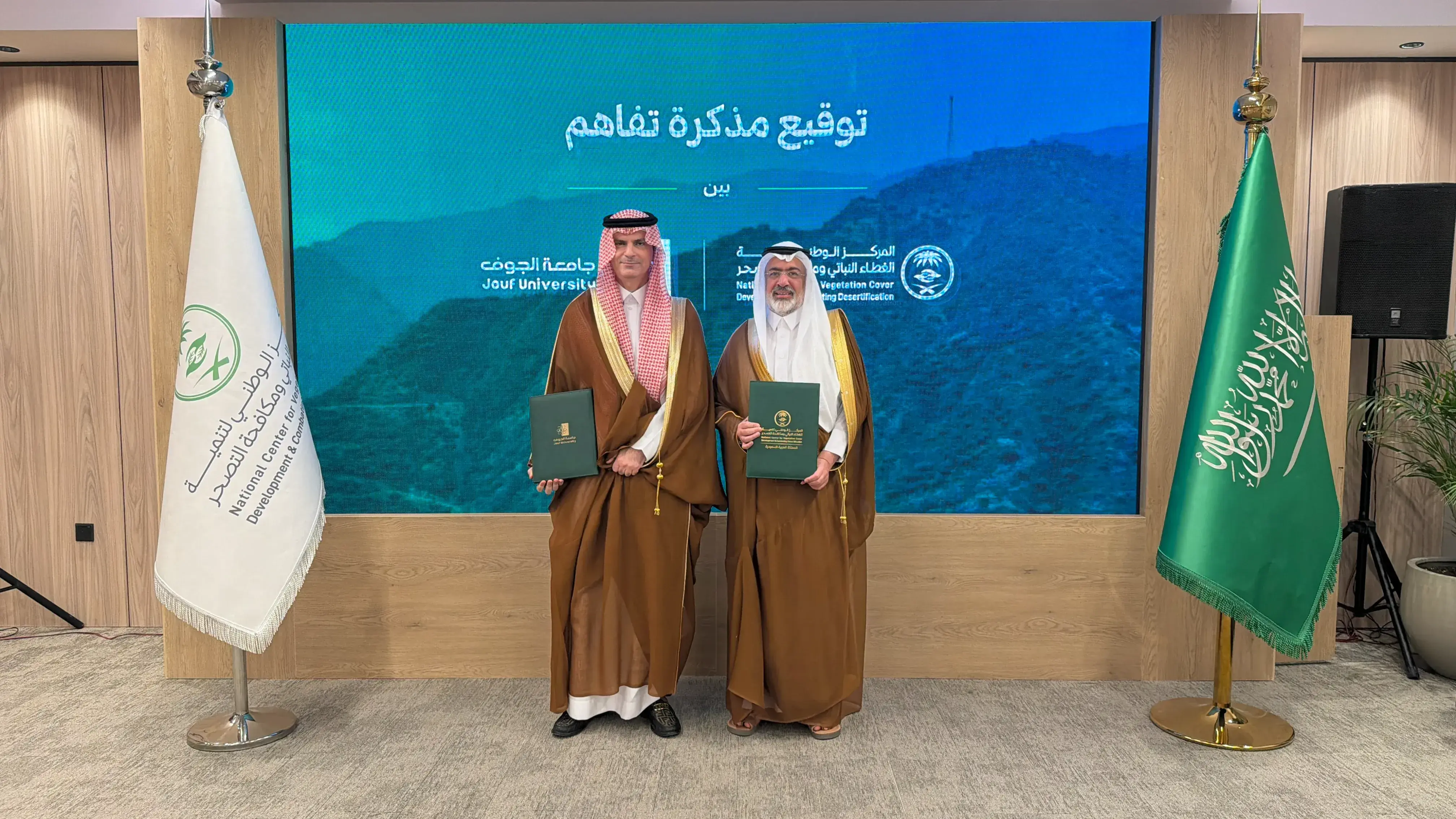
In a strategic step reflecting its commitment to advancing environmental sustainability and strengthening the role of scientific research in addressing environmental challenges, Jouf University signed a Memorandum of Understanding (MoU) with the National Center for Vegetation Cover Development and Combating Desertification (NCVC). The agreement aims to coordinate scientific and research efforts, develop innovative environmental solutions, and build national capacities, contributing to the protection of natural resources, the development of vegetation cover, and efforts to combat desertification, in line with the objectives of Saudi Vision 2030.
The MoU was signed on behalf of Jouf University by its President, Prof. Mohammed bin Abdullah Al-Shaya, while the National Center for Vegetation Cover Development and Combating Desertification was represented by its Chief Executive Officer, Eng. Ahmed bin Saleh Al-Ayadah. The agreement forms part of ongoing efforts to strengthen strategic partnerships between academic institutions and specialized national organizations, fostering greater integration of their roles in advancing the Kingdom’s environmental and development priorities.
Jouf University President, Prof. Mohammed bin Abdullah Al-Shaya, emphasized that the signing of the MoU reflects the University’s commitment to establishing effective national partnerships that go beyond conventional cooperation to generate sustainable scientific and developmental impact. He noted that environmental sustainability is a key national priority requiring the integration of academic knowledge, specialized expertise, and innovative solutions to address environmental challenges, preserve natural resources, and enhance quality of life.
He further stated that the University is committed to leveraging its scientific and research capabilities while empowering its faculty members, students, and researchers to contribute to practical solutions with measurable impact. He stressed that this partnership provides an important opportunity to advance applied scientific research, align research outcomes with national needs, and support initiatives aimed at developing vegetation cover and combating desertification, in keeping with the Kingdom’s aspirations for a more sustainable future.
Jouf University’s College of Science will represent the University in the areas of cooperation outlined in the MoU, drawing on its academic and research expertise in basic and environmental sciences. Through its contributions to scientific knowledge and applied research related to sustainability and natural resource conservation, the College will help strengthen collaboration between scientific disciplines and technical expertise, facilitating the transformation of research outcomes into practical solutions that benefit the environment and society.
The MoU encompasses several key areas of cooperation, including conducting joint scientific research and studies on vegetation cover development, combating desertification, rehabilitating degraded sites, and developing sustainable environmental solutions. It also provides for the exchange of scientific, technical, and research expertise and resources, as well as the implementation of joint environmental projects and initiatives that support national efforts to protect the environment and ensure the sustainability of its resources.
The agreement also places particular emphasis on investing in human capital and developing national capabilities by providing field and cooperative training opportunities for University students, supporting graduation projects, postgraduate theses, and scientific innovation, and organizing specialized training programs, workshops, and scientific events. These efforts aim to enhance the competencies of national talent, bridge the gap between academic knowledge and practical application, and create new opportunities for students and researchers to participate in addressing environmental challenges.
This partnership builds on Jouf University’s ongoing efforts to expand its network of national partnerships, maximize the developmental impact of its academic and research ecosystem, and reinforce its role as an active scientific institution serving society and advancing sustainable development. It also reflects the University’s commitment to transforming knowledge into impactful initiatives, scientific research into innovative solutions, and institutional partnerships into lasting environmental and developmental outcomes, in alignment with the goals of Saudi Vision 2030